TANGO TIPS – 12 July 2026
The following is a copy of the notes prepared for a “Tango Tips” musicality interlude at the Toca Tango Practilonga in Auckland.
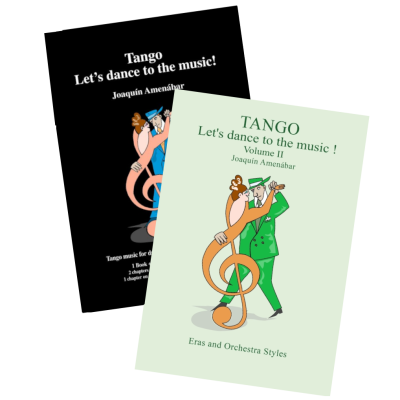 In Joaquin Amenabar’s book on tango dance musicality and the evolution of tango music styles through the decades, he identifies the impact that violin virtuoso Cayetano Puglisi had on many orquestas and in particular, Juan D’Arienzo’s.
As well as playing incredibly beautiful and technically difficult solos, Puglisi (in his own and in many other orquestas) often provided simple low pitched lyrical melodies and counter-melodies, such as those that subsequently became a feature of many D’Arienzo orquesta recordings.
After discussing these melodies and counter-melodies, Joaquin says:
“In this way, the music is giving us three possibilities of dancing:
a) dancing and making movements and figures freely according to the four-beat rhythm,
b) making movements and figures following the main melody of the tango….,
c) dancing the long, slurred notes of the violin solo.”
“Nada Mas” recorded in 1938 by Juan D’Arienzo with vocalist Alberto Echagüe and lead violinist Alfredo Mazzeo, is an example of a tango that has these types of violin solos, as well as having a four-beat rhythm, and a rhythmic melody incorporating staccato and legato phrases together with syncopations, fills and pauses. These can all be heard during the first 40 seconds of the recording (and elsewhere throughout).
Numerous other examples of such solo violin melodies and counter-melodies are also present in a tanda of the 1944 and 1945 D’Arienzo tracks :
“El Romantico”
“Segue Is Podes”
“La Mentirosa”
These 1944 and 1945 solo violin melodies and counter-melodies were played by Cayetano Puglisi, who joined D’Arienzo’s orquesta in April 1940 along with pianist Falvio Salamanca, bandoneonist Hector Varela, and vocalist Héctor Mauré, following a mass resignation of all the orquesta’s previous members in March of that year.
PRACTICAL EXERCISE
For a D’Arienzo vocal tango such as “Nada Mas” –
1. Step to the compas while listening for rhythmic features and variations, refining steps to align with changes between staccato and legato elements; stepping on every compas beat, (taking forward steps throughout each phrase before resolving with a sidestep and close-step).
2. Repeat the exercise, this time dancing to the compas but modifying step rhythms as appropriate as and when there is recognition of:
* rhythmic variations within each phrase
* stops (and “moving” stops)
* repeated phrases
* syncopations
* long “slow” half-time steps (for violin solos)
* other features (like anticipations, drags, etc)
Stu 12 July 2026